What happened in our house
The fridge fit. Until I thought about opening it.
The old fridge already worked next to the wall. I needed to find out whether a different door and handle would work there too.
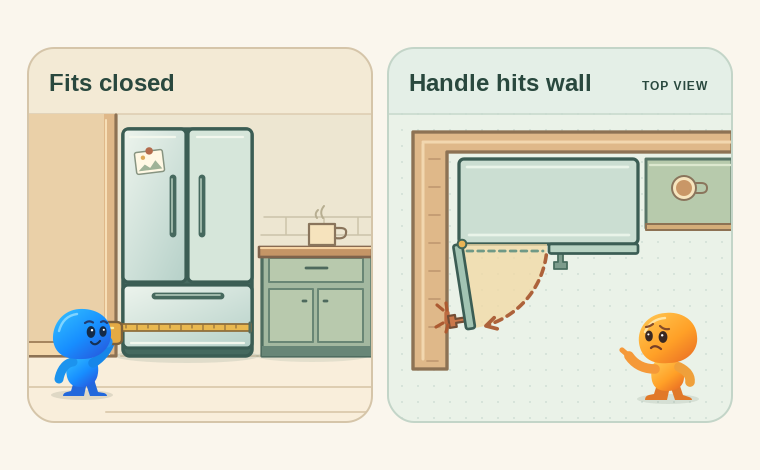
The door needed room too
The Maytag in my kitchen sits next to a wall. There’s roughly seven-eighths of an inch of clearance on that side. The door works, even with a big handle. So when I started looking for a replacement, I figured I had a decent reference point: find another fridge about the same size.
Then I started looking at the doors.
A fridge can fit between two walls and still be a pain to use there. The first measurement tells you whether you can put the thing in the opening. It doesn’t tell you where the door and handle go as they swing, or how far the door needs to open before you can pull out a drawer. The existing Maytag told me the space could work. It didn’t tell me that a different hinge would work the same way.
What I needed the comparison to show
I asked AI to help compare fridges. Early on I was looking at widths, prices and models described as having “zero clearance.” I kept coming back to something more specific: my current handle clears the wall. How does the new door move compared with the one I already know works?
That broke the question into three parts:
- Cabinet fit: Does the body fit the opening with the clearances the manufacturer calls for?
- Door and handle clearance: What happens on the wall side as the door opens? Does the drawing account for the handle, or is that dimension somewhere else?
- Drawer access: How far does that door have to open to use a drawer normally? If I need to remove the drawer to clean it, is that a separate requirement?
Those are things to look up or test, not assumptions to paste into a shopping table. A listing can give you a width without giving you much help on the second and third questions. If the manufacturer’s drawing or manual doesn’t answer one of them, I’d rather see “unknown” than a green check.
Here’s a concrete example. Samsung calls the RF70H30KERAA “Zero Clearance Fit.” Its RF70H30K-series installation manual still calls for 3¾ inches beside a fixed wall for the door swing. The next question is where your wall ends relative to the hinge, not whether the listing says zero. That’s a spec check, not a report of how the model fit in my kitchen.
I compared options and prices, and Best Buy ended up beating Greentoe for me. That settled where I wanted to buy. It didn’t prove how the new fridge would behave against the wall.
Try it for your own kitchen
Write down the model of your current fridge, the opening dimensions, and where the nearest obstruction sits. Include which side has the wall. If you’re comfortable sharing an image, a close-up of that corner is more useful than a photo of the whole room. Find the manufacturer’s dimensional drawing or installation guide for each contender.
Then try this with the AI you already use:
Compare these fridge models for my opening. Keep body fit, wall-side door and handle clearance, and drawer access separate. For each number, link to the manufacturer’s drawing or manual and tell me what the number actually measures. Mark anything that isn’t in the documents as unknown. Tell me what I should measure or try in person before ordering.
Check the diagram yourself. If it gives a measurement for a door at 90 degrees, don’t assume that’s also the angle needed to remove a drawer. A tape measure and a minute opening doors on the floor model can answer a question a spec table can’t.
I went into the search with a width. I came out of it knowing which door I needed to check.